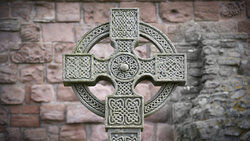
Over one million people speak a variation of the Celtic language. They can be found in Ireland, Wales, Cornwall, Scotland, Isle of Man, Cape Breton (Nova Scotia), Patagonia, and Brittany (France). If you'd like to know how to pronounce basic Celtic words and names, read on for examples and a pronunciation guide, as well as a brief overview of each language.
The Celtic Languages
Today, there are six varieties of Celtic languages spoken in Europe. There are three languages in each of two language families, which vary by location. Some of these languages are still widely spoken by native speakers, while others have died off in favor of other languages.
Goidelic (Gaelic) Languages
The term Gaelic comes from the Gael people, who are native to Ireland and spread to Scotland prior to the Middle Ages. The Gaelic culture has a complex history of clans, kingdoms, and war, and has largely been replaced by English after the 17th century. However, over one million people in Ireland and Scotland still speak a form of Gaelic today.
- Irish: Called Gaeilge in Ireland, Irish Gaelic is one of the two official languages of the Republic of Ireland. It's mainly spoken in the Republic of Ireland in areas known as Gaeltacht. Its three regional dialects are Munster, Connemara, and Ulster.
- Scottish: Scottish Gaelic (Scots Gaelic Gàidhlig) is similar to Irish Gaelic but varies dialectically. It's not as commonly spoken, with about 60,000 native speakers in Scotland and other parts of Europe.
- Manx: A native language to the Isle of Man, Manx has not been spoken there in over 40 years. It was thought to be similar to Ulster Irish.
Brythonic (British) Languages
Native speakers of Brythonic languages hail from other areas of the United Kingdom. Bythronic and Gaelic languages share some of the same words and syntax. However, differences in pronunciation and spelling make it difficult for a speaker of one family to understand a speaker of the other family.
- Welsh: Native Welsh speakers live in the country of Wales. Around 20% of the population of Wales (over 500,000 people) can speak some degree of Welsh.
- Breton: A close dialect match with Cornish, Breton speakers mostly live in Brittany, France. Over 200,000 people can speak the language, but because French is the national language, Breton speakers decrease with each generation.
- Cornish: Around 13,000 residents of Cornwall still speak Cornish today. English has become the primary language of the area; however, there has been a recent effort to restore the Cornish language in both spoken and written formats.
The Irish Language
Here are some pronunciation tips for reading and speaking in Irish Gaelic. Spelling and letter sounds are quite different between Irish and English. Although the pronunciation rules apply mostly to the Ulster dialect, you can apply the basic grammar to the rest of the Irish language.
Pronunciation
A basic Celtic pronunciation guide starts with understanding how vowels and consonants sound in the language.
- Vowels - The vowels are the easiest when learning how to pronounce Celtic names and words. After each vowel is an example of the long and short sound of it: A = pa, ago; E = hey, deck; I = tree, sick; O = woe, sock; U = shoe, duck.
- Consonants - The Irish language has fewer consonants than English. The pronunciation of consonants depends on the vowels that surround it. They can be pronounced in a broad or slender way: the vowels A, O, and U lead to broad sounds, whereas I and E lead to slender sounds. Following are the consonants with examples of the broad and slender sounds. B = b, b; C = k, k; D = d, j; F = f, f; G = g, g; L = l, l; M = m, m; N = n, n; P = p, p; R = rolled r, r; S = s, sh; T = t, ch.
- Aspirated Consonants - Some consonants were originally changed by placing a dot above them. When Irish is printed with the Western alphabet, H is inserted to make this change. This is why you see so many H's in Irish, but it is an operation, not a letter. Here are the aspirated consonants with their broad and slender sounds: BH = w, v; CH = loch, loch; DH = ch with g, y; FH = no sound, no sound; GH = ch with g, y; MH = w, v; PH = f, f; SH = h, h; TH = h, h.
- Eclipsed Consonants - Eclipsing happens at the beginning of a word, and is shown by two consonants together. The first is the letter to be pronounced and the second is the original letter before it was eclipsed. Notice that there is one aspirated consonant in the list: mb, gc, nd, bhf, ng, bp, ts, dt.
- Double Consonants - When there are two consonants together, they are sometimes difficult to say, so an indistinct vowel is sounded between them. When pronouncing "Dublin," for example, there is a very short "uh" sound between the B and the L. These double consonants are: gn, lm, lg, bl, mn, nm, nc, rb, rbh, rch, rg, rm, rn, thn.
- Diphthongs - When two vowels are together, one usually predominates, especially if it is long. The long diphthongs, along with examples, are: AE = tray; AO = me; EO = toe; IA = see a; UA = truant. The short diphthongs are: EA = mass; IO = miss; UI = miss.
- Accent - In Irish, the accent is usually on the first syllable. The only exceptions are compound words. Some of the more common ones are: anois, ariamh, arís, anall, arú, amháin, aneas.
Common Irish Words
Now that you know how to pronounce many Irish words, try out your skills on words and names that are common to the Irish language. You may be surprised how easy they are to pronounce once you know the rules.
- Dia dhuit (Jee-ah ditch or Dee-ah gwitch): Hello
- Gaeilge (Gay-leck): Irish
- Sláinte (Slawn-che): Cheers
- Go raibh maith agat (Guh row mah aguth): Thank you
- Cad is ainm duit? (Codh es anam gwitch?): What is your name?
- Tá brón orm (Ta brohn orum): I'm sorry
- Cara (Cah-rah): Friend
- Eanáir (An-ure): January
- Nollaig (Null-ig): December
Traditional Irish Names
Here are some traditional Irish names, along with their pronunciations:
- Aoibhinn: Ay-veen
- Aoife: Ee-fah
- Caoimhe: Quee-vah
- Cillian: Kill-ee-an
- Diarmuid: Deer-mid
- Eoin: Owen
- Niahm: Neev
- Saoirse: Ser-sha
- Sinead: Shin-naid
- Siobhan: Shiv-awn
- Sionainn: Shannon
Examples of Other Celtic Languages
Want to see the same words across the other five Celtic languages? Here are some more Celtic language examples of words and names in Scottish Gaelic, Manx, Welsh, Breton, and Cornish.
Common Scottish Words
Scottish Gaelic is similar to Irish Gaelic in some ways, such as spelling rules and pronunciation. But, notice how common some sounds are (such as "acht") that you are less likely to find in Irish Gaelic.
- Halò (Ha-law): Hello
- Gàidhlig (Gah-lick): Gah-lick
- Sláinte (Slawn che): Cheers
- Tapadh leat (Tah-puh let): Thank you
- Dè an t-ainm a th 'ort? (Jay un ten-um a horsht?): What is your name?
- Tha mi duilich (Ha mee doo-lich): I'm sorry
- Caraid (Cah-ritch): Friend
- Am Faoileach (Im fuh-lochk): January
- An Dùbhlachd (In do-lochk): December
Traditional Scottish Names
Some common Scottish names include:
- Aileen: Ay-leen
- Baoithein: Booy-en
- Bhaltair: Val-tar
- Coinneach: Coin-nyuch
- Còiseam: Cosh-em
- Lachlan: Lokh-len
- Màiri: May-ree
- Morainn: Mur-in
- Oisian: O-shee-an
- Pàdraig: Paw-drick
Common Manx Words
Even though Manx is not regularly spoken, it's important to understand how words are different from the other Gaelic languages. Here are some common words that you can learn in Manx.
- Moghrey mie (Mora my): Hello
- Gaelg (Glig): Manx
- Slaynt (Slent): Cheers
- Gura mie ayd (Guh-ruh my ed): Thank you
- Cre'n ennym t'ort? (Cren en-nem tort): What is your name?
- S'olk lhiam (S-doog lee-am): I'm sorry
- Bey (Bay): Friend
- Jerrey geuree (Jay-guer): January
- Mee ny Nollick (Mee na null-ick): December
Traditional Manx Names
Some names you'll find in Manx, including their pronunciations, include:
- Abban: Ahb-ann
- Blaanid: Blah-nid
- Cristen: Kris-ten
- Cormac: Core-mack
- Filip: Fill-lip
- Fynn: Finn
- Gorry: Gor-ee
- Graihagh: Gray-uh
- Juan: Joo-un
- Laurys: Lar-is
Common Welsh Words
Welsh pronunciation is phonetic, so words are said the way they are spelled. However, Welsh spelling is not very similar to English.
- S'mae (Shoo-my): Hello
- Cymraeg (Come rye-gg): Welsh
- Iechyd Da (Yeah-key-id dah): Cheers
- Diolch (Dee-olch): Thank you
- Be' dy'ch enw chi? (Bay dich enoo chee?): What is your name?
- Mae ddrwg gen i (May drewg gen ee): I'm sorry
- Fy ffrind (Frind): Friend
- Ionawr (Yone-are): January
- Rhagfyr (Rag-fair): December
Traditional Welsh Names
Some common Welsh names include:
- Alwyn: All-win
- Bowen: Bo-win
- Cledwyn: Cled-win
- Cymreiges: Com-rye-gus
- Dylan: Dill-en
- Ffionn: Fee-own
- Gwendolyn: Gwen-dole-in
- Iago: Ee-ah-go
- Llewellyn: Leh-well-in
- Rhiannon: Ree-ann-on
Common Breton Words
Based in France, Breton has influences of both Celtic and French sounds and syntax. See if you can tell whether Breton is similar or not to other Celtic languages.
- Demat (Dem-ett): Hello
- Brezhoneg (Brez-hon-ig): Breton
- Yec'hed mat (Yeh-ked-maht): Cheers
- Trugarez (Tru-gar-ey): Thank you
- Petra eo da anv? (Pe-tra eh-oh da ah-nuv?): What is your name?
- Eskuzit ac'hanon (Es-cuz-it a-can-on): I'm sorry
- Kamarad (Cam-er-ad): Friend
- Miz Genver (Miz Gen-ver): January
- Miz Kerzu (Miz Kerr-zoo): December
Traditional Breton Names
Traditional names in Breton include the following:
- Armel: Ar-mell
- Deniel: Den-yell
- Gwendal: Gwen-dahl
- Gwilherm: Ghee-err-m
- Katarin: Cat-a-rin
- Nolwenn: Nole-wen
- Padrig: Pa-drig
- Pierrick: Pee-err-ick
- Ronan: Row-nan
- Yann: Yawn
Common Cornish Words
Like Welsh, Cornish pronunciation is phonetic. You can generally tell how to say a Cornish word if you know the rules of Cornish pronunciation.
- Dydh da (Div da): Hello
- Kernewek (Kern-u-ick): Cornish
- Yeghes da (Yecki da): Cheers
- Meur ras (Mure ras): Thank you
- Pyth yw dha hanow? (Pith you da hanow?): What is your name?
- Drog yw genev (Drog you jen-ev): I'm sorry
- Koweth (Co-with): Friend
- Mys Genver (Mis gen-ver): January
- Mys Kevardhu (Mis ke-var-do): December
Traditional Cornish Names
Meeting someone from Cornwall? They may have one of these Cornish names:
- Bryok: Bree-ok
- Cadwur: Cad-ur
- Chesten: Chess-en
- Colan: Coll-an
- Elowen: Ell-oh-wen
- Eseld: Ez-eld
- Ia: Ee-ah
- Jowan: Jo-wan
- Metheven: Meh-theev-en
- Tregereth: Trey-gair-ith
How to Pronounce "Celtic"
The first thing you need to know about a language is how to pronounce that language's name. However, in the case of the Celtic language, the answer isn't so straightforward. There are two ways to pronounce the word "Celtic" based on the word's history.
Celtic like Keltic
The first recorded name of the Celts was the Greek Keltoi, or "barbarians," in 517 BC. The /k/ sound from Keltoi found its way into the Latin word for this ethnic group, Celtae. Latin words adopted by the English language became influenced by the French /s/ sound when placing a "c" before an "e." Therefore, Keltic became Seltic to English speakers.
Celtic like Seltic
Seltic has been the accepted pronunciation of Celtic for centuries. Both the Celtic Football Club (established in 1887) and the Boston Celtics basketball team (established in 1946) pronounce their team names like Seltic. But, when referring to the Celtic culture, the pronunciation of Celtics with a /k/ became popular again in the mid-20th century.
Basically, it's acceptable to say Celtic either way. When referring to the Celtic culture, it's more common to hear the /k/ sound. If you're talking about a publication or organization formed before 1950 or so, you're more likely to hear the /s/ sound.
More Language Resources
Want to learn more about the Celtic languages? Check out an article that explains more about Scottish and Irish Gaelic phrases. Or, see how many Celtic creatures you recognize in this list of mythological beasts.