Names are an important and intrinsic part of a person’s identity. Surnames, in particular, build on your family’s history, but if you’re changing your name, they can set you on a path of your own. Unless you want to be known as “Hey you” all your life, names also have meanings that can reflect the professions of your ancestors, where they came from, and provide a glimpse into their lives.
The Reason for Last Names
In Western culture, last names — also known as family names or surnames — weren’t always a thing. Instead, people’s names often included a reference to where they were from or an epithet, like Alexander the Great or Suleiman the Magnificent. But these days, Dave of Burbank just doesn’t really have the same ring to it.
In smaller civilizations, last names were not necessary because it was unusual to have a large number of people bearing the same given name (first name). However, as time went on, those first names became more common, and the need for last names became apparent.
In practical terms, if there were five Johns in one town, people needed to describe which John from which family they were talking about.
Beyond that, surnames were a means of relating to specific clans or tribes. Some symbolized the bonds between family; others denoted social class.
The Meanings and Etymologies of Surnames
Surname, which refers to an official title or name added to a person’s first name, comes from the Latin combination of sur-, meaning “over or above” and -name. Understanding last name etymology involves tracing the meaning behind the names commonly used by different cultures and nationalities. Most are based on specific occupations, personality characteristics, and other descriptive traits.
Last Names Based on Occupation
Some surnames come directly from the occupation of the first person who had the name. You can easily imagine how residents in a small town would need to differentiate between George the Baker and George the Butcher. Adding the occupation makes it clear. Here's George Baker, and there's George Butcher.
Other surnames with an occupational origin include:
- Taylor - a tailor or someone who makes clothing (from Old French tailleur)
- Brewer - someone who brews beer (from Middle Low German brauer)
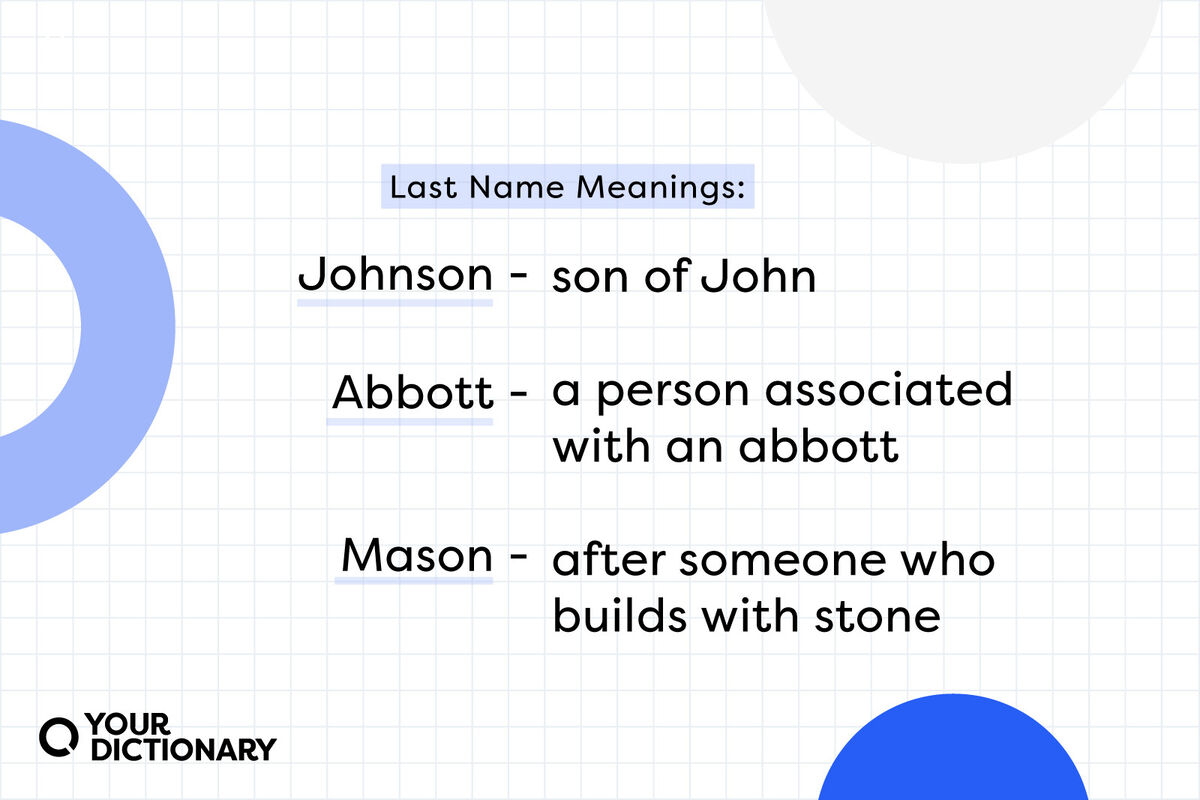
- Mason - a stoneworker or person who lays bricks (from Old French masson)
- Carpenter - a person who builds with wood (from Middle English carpentier)
- Fletcher - a person who makes feathered arrows (from Old French fleche)
- Smith - a blacksmith or metalworker (from Old English smitan)
- Miller - someone who grinds grain (from Middle English mille)
- Tanner - a person who tans, or preserves, animal hides (from Old English tannian)
- Draper - someone who makes or sells cloth (from Old French drapier)
- Fisher - a person who fishes (cognate of German Fischer)
Place-Based Surnames
Other surnames are related to specific places. Also called toponymic surnames, these names made it clear exactly who you were talking about by describing where that person lived or where they came from.
- Dale - someone who lived in a wide valley (from Old English dæl)
- Forrest - a person who lived in the forest
- Milford - a person who lived near a mill on a ford
- Bell - someone who lived close to the town's bell
- Brook - someone who lived near a running stream (from Old English broc)
- Underhill - a person who lived under or at the base of a hill (from Old English under and hyll)
- Atwood - a person who lived in the woods (Middle English)
- Banks - someone who lived near a bank of land
- Abbey - someone who lived near an abbey (from Middle English abbeye)
- Moore - a person who lived on a moor or open marsh land (from Middle English mor)
- Moorhead - a person who lived at the head of a moor
Last Names With Personal Characteristics
Some last names started as just adjectives that described someone's personality or physical appearance. In this way, John with the red hair could be differentiated from John with the black hair.
Many names offer a clue about the personal characteristics of your ancestors, like these examples:
- Stout - someone who has a sturdy build
- Strong - a person of great physical strength
- Young - someone who is not yet old, possibility used to differentiate between generations
- Short - a person whose height is less than average
- Long - a tall person
- Black - someone with black hair
- Brown - someone with brown hair
- Stern - a person who is serious
- Swift - a fast person
Last Names Showing Lineage
Last names can also communicate family connections. Often, this would be used for the second or subsequent generation, referring to a father's first name or occupation.
These types of last names are also called patronymic surnames.
- Johnson - son of John
- Thompson - son of Thomas
- Jackson - son of Jack
- Smithson - son of the smith
- Larson - son of Lars
- Nelson - son of Nels
- Stevenson - son of Steven
- Hansen - son of Hans
- Oleson - son of Ole
- Richardson - son of Richard
- O'Sullivan - son of Sullivan
- O'Reilly - son of Reilly
- McArthur - son of Arthur
Surnames Indicating Royalty or Importance
Surnames could also indicate that someone came from royalty or had the blessing of royalty. Alternatively, it could be an indication that the person had a connection to other important people in the community, such as religious leaders.
- Prince - someone associated with the prince
- Abbott - a person associated with an abbott
- Steward - someone appointed by royalty to act on the royal's behalf
- King - a person associated with the king
- Fitzroy - someone who was an illegitimate son of a king
- Lord - a person associated with a lord
- Rector - an administrative leader in the church
- Dean - a cleric with a position of authority in the church
- Viceroy - similar to Steward, someone acting on the behalf of royalty